


- Privacy Policy
- Terms & Conditions
- Contact us
- ©Isabel Healthcare 2025
March 18, 2026



Meningococcal infections (including meningococcal meningitis, meningococcal septicaemia, and invasive meningococcal disease) are caused by Neisseria meningitidis, which commonly resides in the nasopharynx. In most individuals, carriage is asymptomatic; however, in a small proportion, the bacteria invade the bloodstream or central nervous system, leading to rapidly progressive and potentially fatal illness.
Transmission occurs via respiratory droplets or direct contact with respiratory secretions, particularly in close-contact settings such as households, schools, and university accommodation.
Since our original 2012 blog, the UK landscape of invasive meningococcal disease (IMD) has changed significantly due to vaccination programmes. However, recent clusters and ongoing cases in the UK highlighted by the UK Health Security Agency show that early recognition remains critical.
Epidemiology (UK 2026)
In the UK, invasive meningococcal disease (IMD) is now rare but remains life-threatening. UK surveillance data from public health agencies shows:
- Incidence: approximately 0.5–1 per 100,000 population annually, with year-to-year variation
- Most common serogroups: B and W, with occasional Y cases
- Highest risk groups:
- Infants <1 year (highest incidence, predominantly MenB)
- Children under 5 years
- Adolescents and young adults (secondary peak due to carriage and transmission)
- Seasonal variation: winter and early spring peaks
- Increased risk associated with:
- Close living conditions (e.g., dormitories)
- Close contact exposure via kissing, sharing drinks and sharing vapes
- Concurrent viral infections (e.g., influenza)
The UK has seen a significant decline in serogroup C disease due to vaccination, and MenW cases reduced following adolescent MenACWY rollout.
Key Features of Invasive Meningococcal Disease
Invasive meningococcal disease is characterised by rapid progression, often deteriorating within hours.
Early symptoms (often non-specific)
- Fever
- Irritability or lethargy
- Limb (leg) pain – an important early sepsis clue
- Cold hands and feet (early circulatory compromise)
- Pale or mottled skin
Progressive features
- Headache
- Neck stiffness
- Photophobia
- Confusion or altered consciousness
- Nausea/vomiting
- Seizures
Late or severe features (red flags)
- Hypotension (shock)
- Non-blanching rash (petechiae or purpura)
- Reduced consciousness
- Respiratory distress
Patients should seek urgent care via NHS 111 or emergency services (999) if concerned about any of these symptoms.
The Non-Blanching Rash (“Glass Test”)
The classic non-blanching rash remains a critical sign, though it may be absent early in the disease.
In the UK, public health messaging continues to promote the “glass test”:
- Press a clear glass firmly against the rash
- If the rash does not fade, seek urgent medical attention immediately
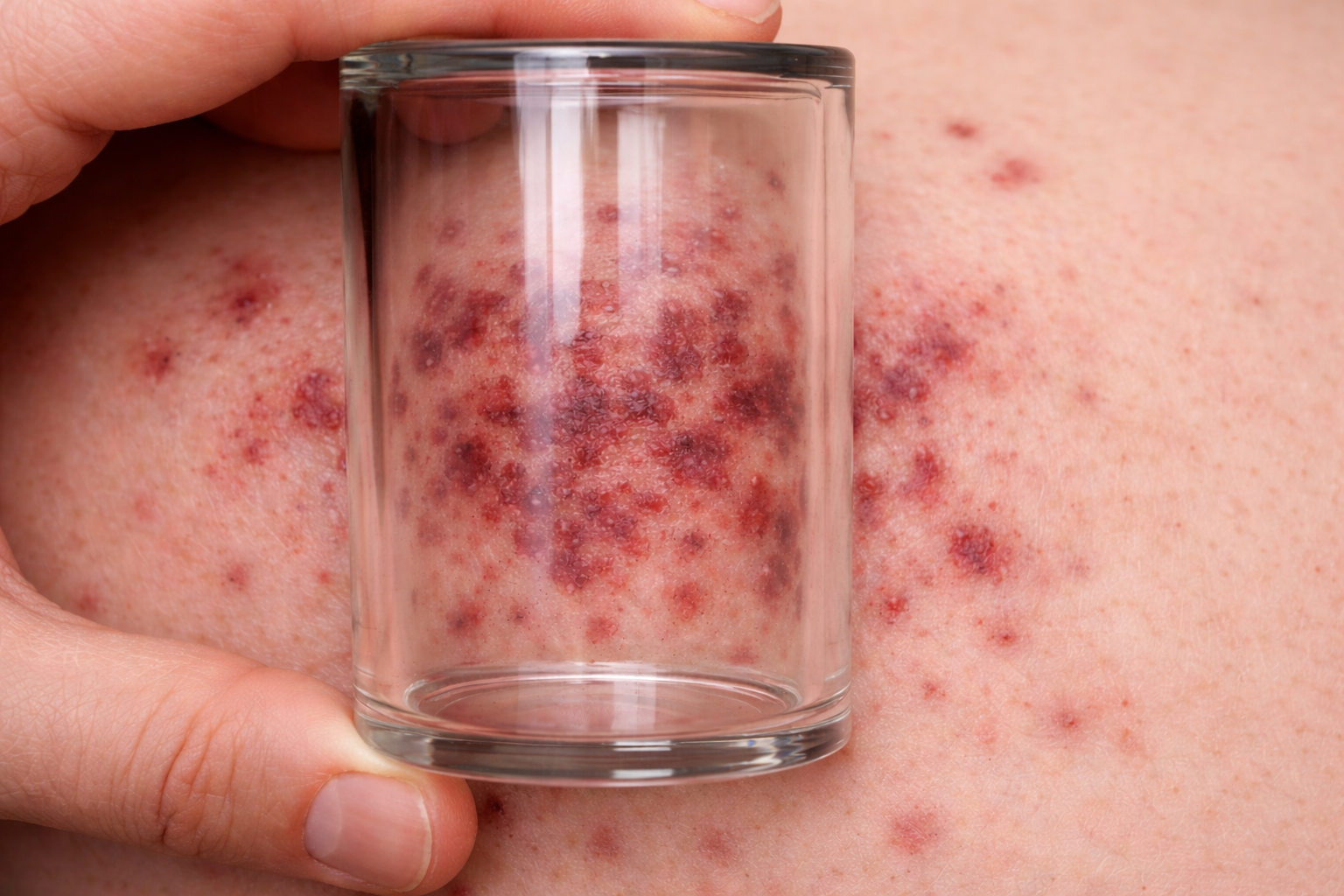
Glass test - press side of clear glass firmly against skin, if rash does not fade under pressure -seek immediate medical attention as is a non-blanching rash
Parents should be reminded: do not wait for a rash to appear—many severe cases present before rash onset.
Important Clinical Points
- Only some symptoms may be present initially
- Disease can mimic viral illness early
- Rash is not always present
- A high index of suspicion is essential in any acutely unwell patient with fever
- Early sepsis signs (limb pain, cold extremities) are often under-recognised but critical to early recognition and immediate treatment
Management
Invasive meningococcal disease is a medical emergency.
Immediate actions
- Administer IV antibiotics immediately as soon as meningococcal septicaemia is suspected (do not delay for tests)
- In the community: IM/IV benzylpenicillin if meningococcal septicaemia is suspected (per UK guidance)
First-line hospital treatment
- IV ceftriaxone (or cefotaxime)
- Supportive care:
- Fluid resuscitation
- Oxygen
- Management of shock and organ dysfunction
Investigations
Do not delay antibiotics for investigations.
Essential tests
- Blood cultures
- Full blood count, CRP
- Coagulation profile (DIC risk)
- Urea and electrolytes
Additional diagnostics
- PCR testing (rapid and highly sensitive)
- Lumbar puncture (if safe and patient stable)
- Imaging (CT head if indicated before LP)
Lumbar puncture is contraindicated in:
- Shock or cardiorespiratory instability
- Coagulopathy
- Signs of raised intracranial pressure
Prognosis
- Overall mortality: ~5–10%
- Higher in meningococcal septicaemia (up to 10–20%)
- Most deaths occur within 24 hours of symptom onset
Long-term complications (10–20% of survivors)
- Hearing loss
- Neurological impairment
- Limb loss (amputation)
- Cognitive deficits
Vaccination in the UK
Current UK meningococcal vaccination programme:
1. MenB vaccine (introduced 2015)
- Given at:
- 8 weeks
- 16 weeks
- 1 year booster
Has significantly reduced infant MenB disease but individuals born before the introduction of the MenB programme in 2015 may not have received routine MenB vaccination, leaving some adolescents and young adults more susceptible.
2. MenACWY vaccine (adolescents)
- Offered to:
- Teenagers (~13–14 years)
- University entrants (catch-up)
- Protects against A, C, W, and Y strains
Impact of Vaccination
- Marked reduction in MenC disease
- Significant decline in MenW following adolescent vaccination
- MenB cases reduced in vaccinated infants, though not eliminated
Vaccination has transformed the UK epidemiology, but:
Meningococcal disease has not been eradicated — early diagnosis remains critical.
Key Takeaways
- Meningococcal disease is rare but rapidly fatal
- Early symptoms are often non-specific
- Do not rely on rash for diagnosis
- Immediate antibiotics save lives
- Vaccination has reduced disease burden but not eliminated risk
Although vaccination has reduced the burden of disease, meningococcal infection remains a time-critical diagnosis. For clinicians and parents alike, early recognition and immediate treatment continue to be the most effective ways to save lives.
Mandy Tomlinson
Mandy has worked for Isabel Healthcare since 2000. Prior to this, she was a Senior Staff Nurse on the Pediatric Infectious disease ward and high dependency unit at one of London's top hospitals, St Mary’s in Paddington which is part of Imperial College Healthcare NHS Trust. Her experience in the healthcare industry for the past 33 years in both the UK and USA means she's a vital resource for our organization. Mandy currently lives and works in Scottsdale, Arizona.